
5 min read
Starting a business is an exciting journey, and one of the first decisions you’ll make is choosing the right legal structure.
In India, Private Limited Companies (Pvt Ltd) and Limited Liability Partnerships (LLPs) are the two most preferred business structures for entrepreneurs. Both provide limited liability protection and have a separate legal identity, but they differ significantly in ownership, compliance, fundraising capabilities, and scalability.
The structure you choose today can influence your business’s growth, ability to attract investors, and ongoing compliance obligations. This guide explains the key differences between a Private Limited Company and an LLP, helping you make an informed decision.
Key Takeaways
- Both Private Limited Companies and LLPs offer limited liability protection.
- Private Limited Companies are generally preferred by startups and businesses planning to raise investment.
- LLPs involve comparatively lower compliance and are well-suited for professional and closely held businesses.
- The right choice depends on your business model, growth plans, and long-term objectives.
Quick Comparison
| Particulars | Private Limited Company | LLP |
|---|---|---|
| Governing Law | Companies Act, 2013 | LLP Act, 2008 |
| Separate Legal Entity | ✔ Yes | ✔ Yes |
| Limited Liability | ✔ Yes | ✔ Yes |
| Minimum Members | 2 Shareholders & 2 Directors | 2 Partners |
| Maximum Members | 200 Shareholders | No statutory limit |
| Fund Raising | Easy | Comparatively Difficult |
| Venture Capital Investment | Preferred | Rare |
| Employee Stock Options (ESOPs) | Allowed | Not Permitted |
| Compliance Requirements | Higher | Lower |
| Ownership Transfer | Easy through share transfer | Governed by LLP Agreement |
| Best Suited For | Startups & Growth Businesses | Professional Firms & Small Businesses |
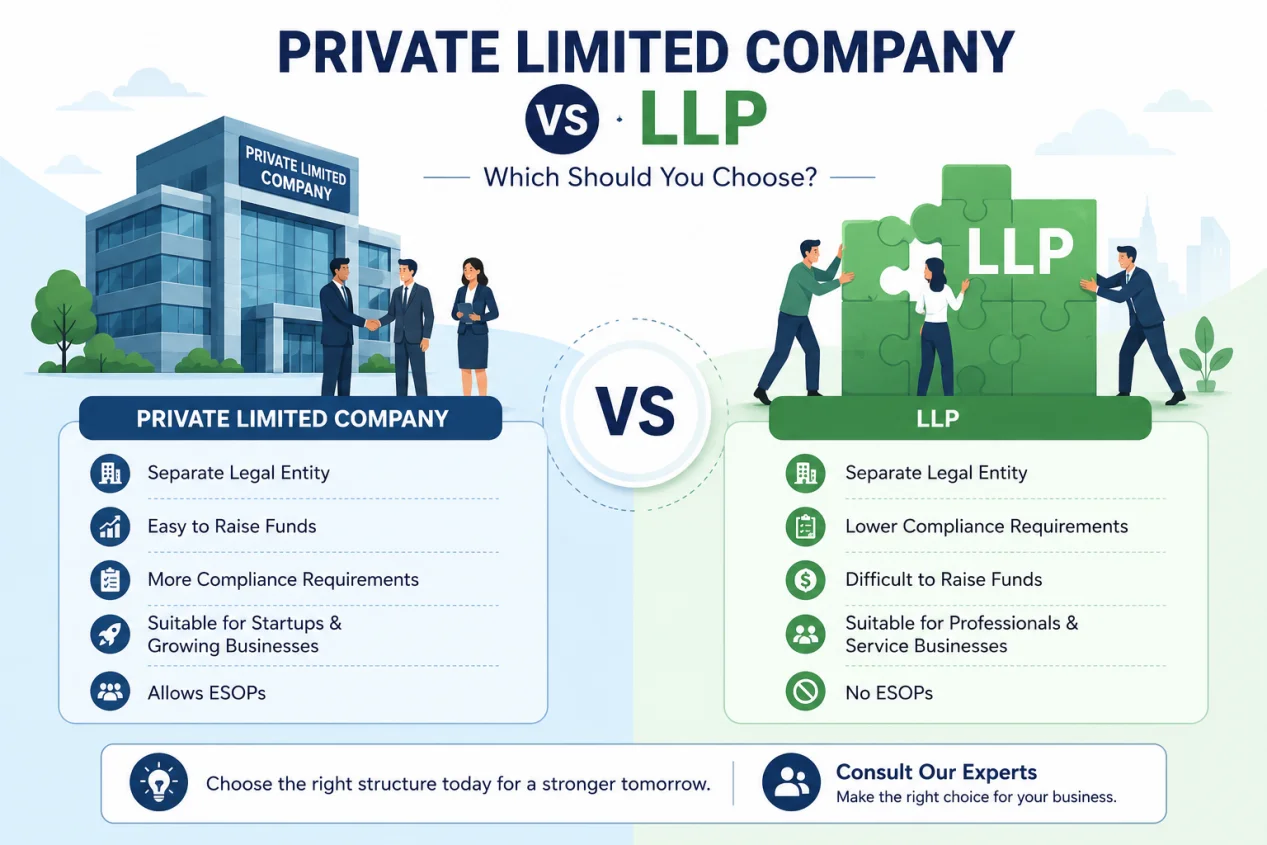
🏢 What is a Private Limited Company?
A Private Limited Company is one of the most popular business structures in India, particularly for startups and businesses with long-term growth ambitions.
It is a separate legal entity incorporated under the Companies Act, 2013. Ownership is divided into shares held by shareholders, while the day-to-day affairs are managed by directors.
This structure is widely recognised by banks, investors, venture capital funds, and corporate clients, making it an ideal choice for businesses looking to scale.
Advantages
- Separate legal identity
- Limited liability protection
- Easy to raise investment
- Better business credibility
- Easy transfer of ownership through shares
- Ability to issue ESOPs to employees
- Suitable for expansion and future fundraising
Things to Consider
- Higher annual compliance requirements
- Regular ROC filings and statutory records
- Greater corporate governance obligations
🤝 What is an LLP?
A Limited Liability Partnership (LLP) combines the flexibility of a traditional partnership with the benefit of limited liability.
An LLP is governed by the Limited Liability Partnership Act, 2008. Unlike a company, there are no shareholders—ownership and management remain with the partners.
Because of its operational flexibility and relatively lower compliance burden, LLPs are commonly chosen by professionals and service-based businesses.
Advantages
- Limited liability protection
- Lower compliance requirements
- Flexible internal management
- Lower recurring compliance costs
- Ideal for professional practices and family-owned businesses
Things to Consider
- Raising external investment can be challenging
- ESOPs cannot be issued
- Ownership transfer is comparatively less straightforward
- Less preferred by venture capital investors
Key Differences Between a Private Limited Company and an LLP
📑 1. Compliance Requirements
A Private Limited Company is governed by the Companies Act, 2013 and is subject to a structured compliance framework. This includes statutory filings, maintenance of registers, corporate records, and other governance requirements.
An LLP, on the other hand, has comparatively fewer compliance obligations, making it easier and more cost-effective to manage.
If reducing compliance is your priority, an LLP has an advantage.
💰 2. Fund Raising
One of the biggest advantages of a Private Limited Company is its ability to raise capital.
Angel investors, venture capital firms, and institutional investors generally prefer investing in Private Limited Companies because equity ownership is easier to structure.
LLPs are rarely used for venture-funded businesses.
Winner: Private Limited Company
📈 3. Business Growth & Scalability
If you plan to expand your business, onboard investors, issue ESOPs, or attract strategic partners, a Private Limited Company offers greater flexibility.
While LLPs are excellent for stable businesses, they are generally not the preferred structure for high-growth startups.
Winner: Private Limited Company
🔄 4. Ownership & Transferability
Ownership in a Private Limited Company is represented by shares, making transfer of ownership relatively simple.
In an LLP, admission, retirement, or transfer of a partner’s interest is governed by the LLP Agreement and may involve additional procedural requirements.
Winner: Private Limited Company
🏦 5. Business Credibility
Private Limited Companies are generally perceived as more structured and investment-ready by banks, financial institutions, government agencies, and corporate clients.
LLPs also enjoy strong credibility, particularly among professional firms such as consultants, architects, accountants, and legal practitioners.
💸 6. Cost of Compliance
An LLP generally involves lower annual compliance costs compared to a Private Limited Company.
If your business does not require external funding and you wish to minimise ongoing compliance costs, an LLP can be a practical choice.
Winner: LLP
Which One Should You Choose?
Choose a Private Limited Company if you:
- Plan to raise funds from investors.
- Want to build a scalable business.
- Need better credibility with customers and banks.
- Intend to issue ESOPs to employees.
- Expect to onboard multiple shareholders.
- Plan for long-term expansion.
Choose an LLP if you:
- Operate a professional or consulting business.
- Prefer lower compliance requirements.
- Do not require external funding.
- Want flexible management among partners.
- Own a family-run or closely held business.
Frequently Asked Questions
1. Which is better: a Private Limited Company or an LLP?
There is no one-size-fits-all answer. The right structure depends on your business goals, funding plans, compliance preferences, and future growth strategy.
2. Can an LLP be converted into a Private Limited Company?
Yes. Subject to the applicable legal provisions and procedural requirements, an LLP can be converted into a company.
3. Which structure is better for startups?
Most startups choose a Private Limited Company because it is generally preferred by investors and offers greater flexibility for future growth.
4. Is annual compliance higher for a Private Limited Company?
Yes. Private Limited Companies have more extensive compliance requirements than LLPs.
5. Which structure is more suitable for consultants and professionals?
An LLP is commonly preferred by consultants, lawyers, accountants, architects, and other professional service providers due to its flexibility and comparatively lower compliance burden.
Conclusion
Both a Private Limited Company and an LLP provide the benefits of limited liability and a separate legal identity. However, the right choice depends on your business objectives.
If your vision is to build a high-growth business, attract investors, and expand rapidly, a Private Limited Company is generally the more suitable option.
If you operate a professional practice or a closely held business and prefer lower compliance with greater operational flexibility, an LLP can be an excellent choice.
Choosing the right business structure at the outset can save significant time, cost, and effort as your business grows.
Ready to incorporate? Read our step-by-step guide: How to Register a Private Limited Company in India.
Need Help Deciding?
Choosing the right business structure doesn’t have to be complicated.
At Founder’s Buddy, we help entrepreneurs evaluate their business model, growth plans, funding requirements, and compliance obligations before recommending the most suitable structure.
📞 Talk to Our Experts 🚀 Register Your Business with Founder’s Buddy